
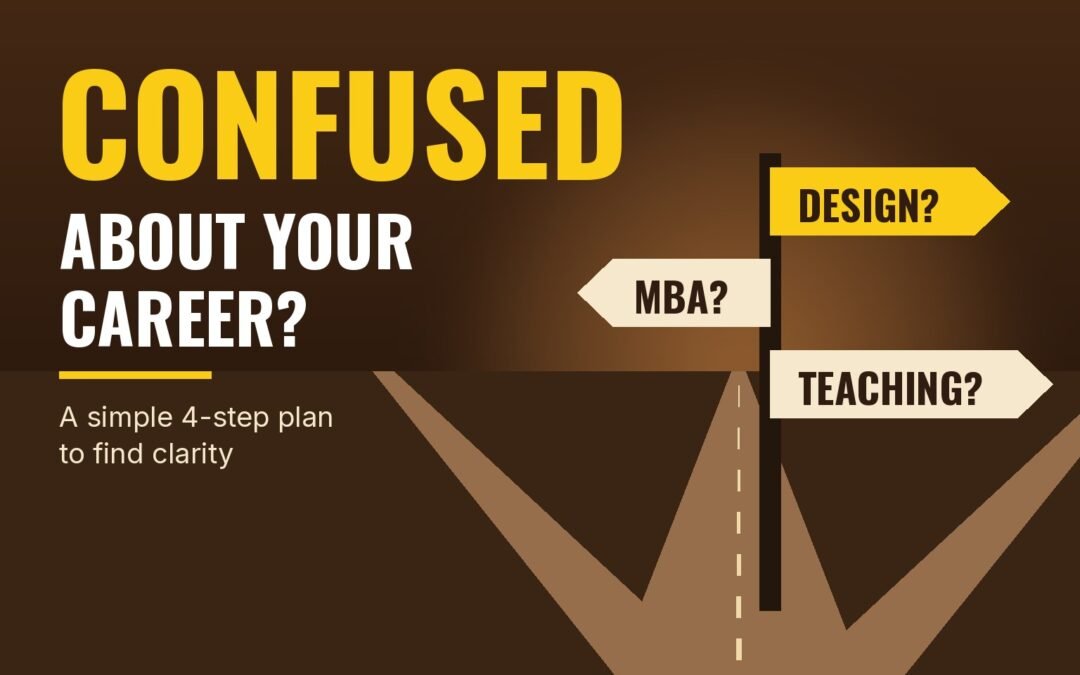
“What do you want to do in life?” If that question makes your stomach drop, you’re not alone. Feeling confused about your career is one of the most common things I hear, from college students choosing a stream, from people in their twenties in their first job, and from people with ten years of experience who suddenly feel “this isn’t me.”
Career confusion doesn’t mean you’re lost or lazy. Most of the time, it means you’re asking the right question in the wrong way.
In this post, I’ll share why it happens, why “find your passion” advice often makes it worse, and a practical four-step plan to move from confusion to clarity.
Why Am I So Confused About My Career?
Career confusion usually comes from a mix of these reasons. See which ones fit you:
- Too many options, too little information. There are hundreds of career paths, but most of us know very little about what the work actually looks like day to day.
- Choices made for us. Many of us chose a stream or degree because of marks, family expectations or what felt “safe.” Years later, we realise we never really chose it ourselves.
- Fear of the wrong choice. We believe one decision will decide our whole life, so we’re scared to decide at all.
- Not knowing yourself well. If you’ve never had space to explore what you enjoy and what you’re good at, it’s hard to know where you fit.
There’s also the pressure of time. When friends seem settled in jobs, postings or business, it’s easy to feel you’re running late. But a rushed choice made just to “catch up” often leads to more confusion a few years later.
In India, there’s often an extra layer. Engineering, medicine, CA or a government job can feel like the only “proper” options. If your interest lies somewhere else, the confusion can come mixed with guilt.
The Myth of the “One Perfect Career”
The biggest trap is believing there’s one perfect career waiting for you, and that you must find it before taking any step.
Bill Burnett and Dave Evans, who teach the Designing Your Life course at Stanford University, challenge this directly. In their book Designing Your Life, they argue there are many possible lives you could live well, not one right answer.
One exercise from their approach is called Odyssey Plans. You sketch three very different versions of your next five years:
- The path you’re on now
- What you’d do if that path suddenly disappeared
- What you’d do if money and what people think didn’t matter
You don’t have to pick one. The point is to see that you have more than one possible future, and that takes away a lot of pressure.
Many confused people get stuck in research mode: thinking, asking everyone for advice, but never testing anything. If that sounds like you, my post on how to make better decisions without overthinking will help you break that loop.
Clarity Comes From Action, Not From Thinking
You can’t think your way to career clarity. You find it by doing small things and noticing how they feel.
Interest often grows after you’ve spent time on something, built some skill and seen some results. Waiting to “feel the passion” before you start is like waiting to feel fit before going to the gym.
So instead of asking “What is my passion?”, ask questions you can actually answer:
- What kind of problems do I enjoy solving?
- When does time fly for me?
- What do people often ask me for help with?
- In what kind of environment do I do my best work?
Your answers won’t give you a job title straight away. They give you direction, and direction is enough to start.
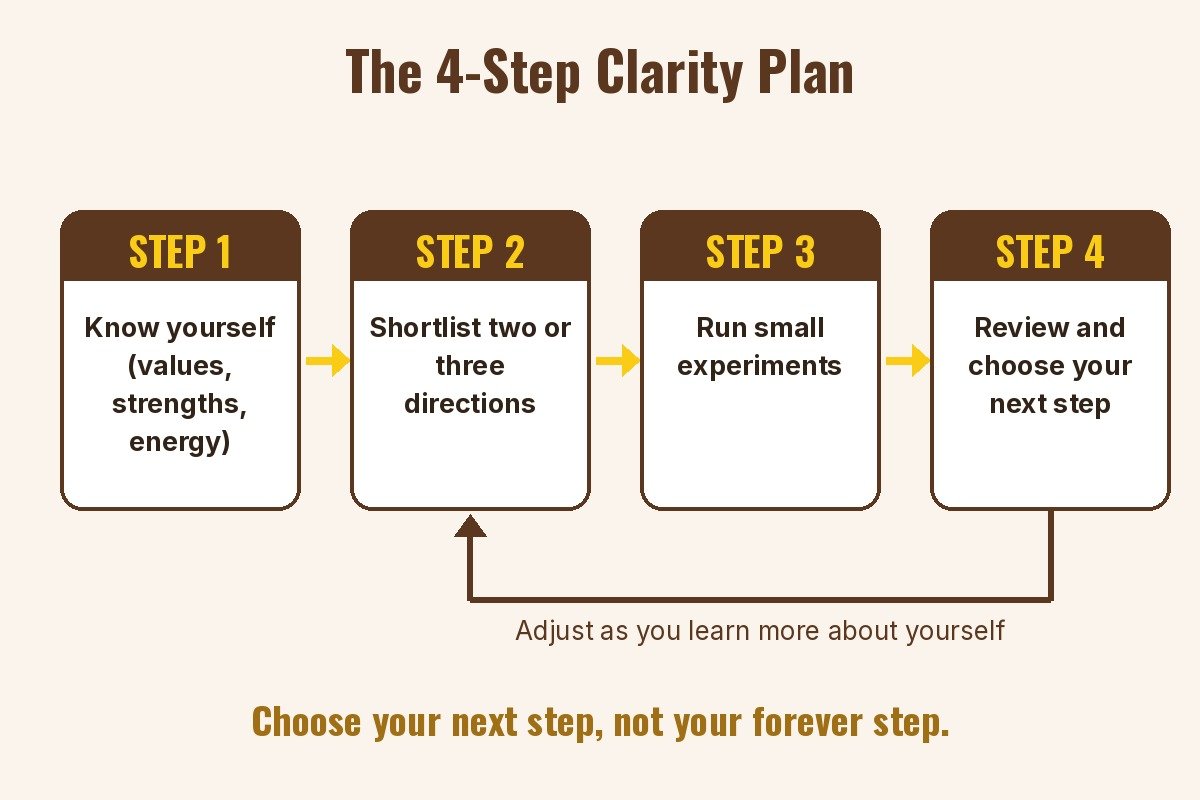
What to Do When You’re Confused About Your Career: The 4-Step Clarity Plan
Step 1: Know yourself (values, strengths, energy)
How to do it: Take 30 minutes and make three lists. First, what matters to you in work (security, freedom, creativity, helping people, money). Second, what you’re naturally good at. Third, an energy check: for one week, note which tasks leave you energised and which leave you drained. Be honest, not “ideal.”
If this feels hard, message two or three people who know you well: “What do you think I’m naturally good at?” Others often notice strengths we take for granted.
Example: Imagine Nidhi, 24, with a B.Com, working in accounts in Surat. Her lists show she values creativity and gets the most energy from making things look good and explaining ideas to people.
Step 2: Shortlist two or three directions
How to do it: Don’t choose from fifty options. Based on your lists, write two or three directions worth exploring. For each one, write one line: “This fits me because…” If you can’t finish that line, it probably doesn’t belong on the list.
Example: Everyone tells Nidhi to do an MBA, but she can’t finish the “fits me because” line for it. She shortlists graphic design and teaching instead.
Step 3: Run small experiments
This is the step most people skip. For each direction, find a low-risk way to test it over the next few weeks:
- Talk to two people who already do that work. Ask: “What does a normal day look like? What do you find hardest? What do you wish you’d known before starting?”
- Do a short online course or a free workshop
- Take on a small freelance task, internship or volunteer project
- Build one small sample piece of work
Example: Nidhi takes a short online design course and makes social media posts for a friend’s small business. She also volunteers to take a weekend class for children.
Step 4: Review and choose your next step
How to do it: After each experiment, answer three questions: Did this give me energy? Did I want to learn more? Could I see myself doing this for the next few years? Score each direction from 1 to 5 on each question, and pick the highest.
Example: Nidhi finds she loved the design work and wanted to keep going, while teaching felt good but tiring. Her next step is a longer design course while keeping her job. That’s a choice based on real experience, not guesswork.
Careers today are rarely straight lines. Choose your next step, not your forever step, and adjust as you learn more about yourself.
How to Talk to Your Family About Career Confusion
In many Indian homes, career decisions are family decisions. Pressure usually comes from love and worry, so a clear plan calms people more than an argument does.
- Share the plan, not just the feeling. Instead of “I don’t like my job,” try: “I’m testing two directions over the next three months, and I’ll keep my job while I do it.”
- Ask for their input on one thing. “You know me well. What do you think I’m good at?” People resist less when they feel included.
- Set a review date. “Let’s talk again after three months, when I know more.” It shows you’re being responsible, not impulsive.
If career confusion and family pressure leave you feeling low or anxious for a long time, please talk to a qualified mental health professional as well. That support can make the whole process lighter.
FAQs
Is it okay to be confused about your career?
Yes, it’s very normal, especially in your late teens and twenties, and during mid-career changes. Confusion is often a sign that you’re outgrowing old choices and want something that fits you better.
How do I choose a career when I’m confused?
Understand your values, strengths and energy, shortlist two or three directions, and test them through small experiments like conversations, short courses or projects. Choose based on what you learn, not just what you imagine.
How do I deal with career confusion and pressure from family?
Share a clear plan with your family, including the small steps you’re taking and a date to review together. Families often worry less when they can see a plan.
Try This Today
Each of these takes less than 10 minutes:
- Write your three lists in quick draft form: what matters to you, what you’re good at, and what gives you energy.
- Message one person who works in a field you’re curious about and ask for a 15-minute chat.
- Answer one question honestly: “If what people think didn’t matter, what would I explore first?” Write the answer down and keep it.
Career clarity isn’t a lightning moment. It’s built one small experiment at a time.
If you’ve been stuck in the same confusion for months, or you feel like you’re living a career someone else chose for you, you don’t have to work it out alone. Career clarity is one of the areas I work on in life and career coaching in Surat or online. Sometimes the confusion is linked to a deeper question of identity, which I’ve written about in why you feel stuck in life.
Ready to get clear on your direction? Book a free 30-minute coaching call with me and let’s work out your next step together.