
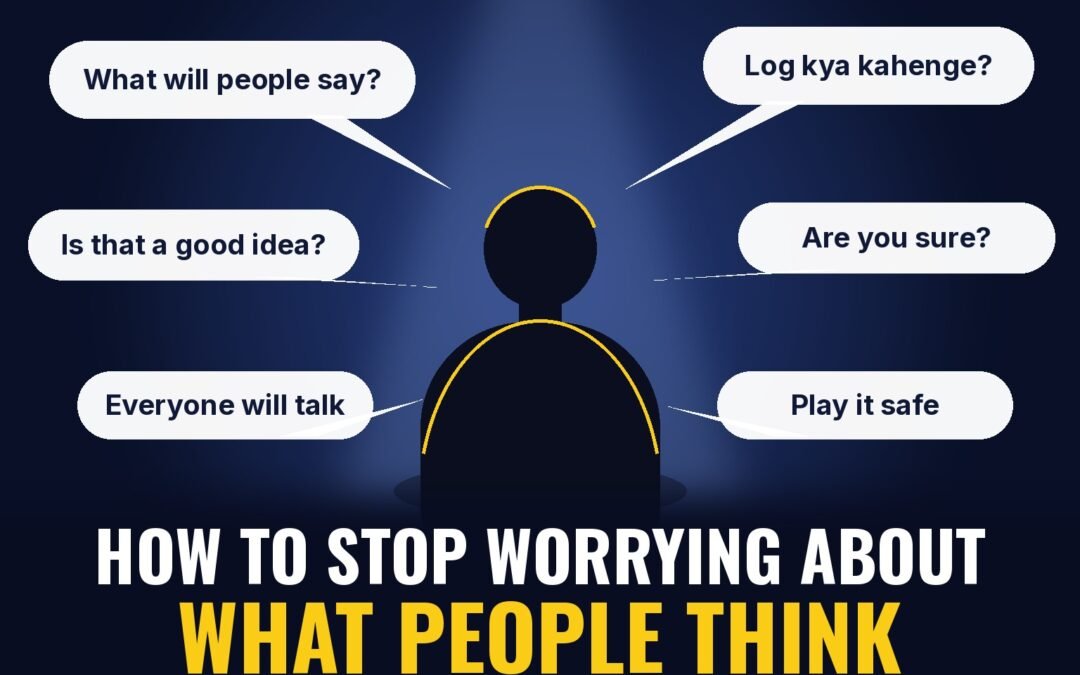
If you want to learn how to stop worrying about what people think, let me start with something honest: you’re not weak for caring. Most of us grew up hearing one line again and again: “Log kya kahenge?” What will people say?
We heard it when choosing a stream, a dress, a partner, a business idea, even how loudly we laughed at a wedding. So it’s no surprise that as adults, many of us still run our decisions past an invisible committee before we act.
In this post I’ll show you why this fear feels so strong, what it quietly costs you, and a four-step method I use to loosen its grip, without becoming rude, cold or careless about the people you love.
Why Do We Care So Much About What People Think?
Wanting to be accepted is a basic human need, not a flaw. For most of human history, being part of the group meant safety. Your mind still treats disapproval as a small threat.
In India, there’s an extra layer. Families are close, communities are tight, and our choices often feel like they belong to everyone. One comment from a relative at a family function can stay in your head for weeks.
So caring isn’t the problem. It becomes a problem when you notice signs like these:
- You decide what “they” will think before you’ve asked yourself what you want
- You replay one comment again and again
- You avoid new things because you might look foolish
- You say “it’s fine” when it isn’t, just to avoid being judged
If two or more of these sound like you, “log” has quietly become your boss.
The Spotlight Effect: People Notice Far Less Than You Think
One piece of research genuinely changed how I see this. In 2000, psychologists Thomas Gilovich, Victoria Medvec and Kenneth Savitsky at Cornell University asked students to walk into a room full of peers wearing a T-shirt they found embarrassing.
Afterwards, the students estimated that about half of the people in the room (46%) had noticed the shirt. In reality, only about 23% had. The researchers called this the spotlight effect: we feel a spotlight is on us, when most people are busy thinking about themselves.
Try this quick check. Can you remember what your cousin wore at the last wedding you attended? Or a small mistake a colleague made in a meeting last month? Most of us can’t. And most people won’t remember yours either.
A lot of the judgement we fear happens inside our own head, not in theirs.
What Worrying About Others’ Opinions Really Costs You
The cost is rarely one big disaster. It’s a slow leak:
- You delay. The course, the reel, the side business all wait for a “safer” time that never comes.
- You shrink. You speak less in meetings and keep your best ideas to yourself.
- You overthink. Every message and outfit gets checked again and again. If this sounds familiar, my guide on how to stop overthinking and take action will help too.
- You lose touch with yourself. After years of living for approval, many people honestly don’t know what they want anymore.
That last one is the deepest cost. When your choices are built around other people’s reactions, your identity slowly gets built around them too. I’ve written more about this link in why you feel stuck in life.
To see your own cost clearly, finish this sentence three times on paper: “If I didn’t care what people think, I would…” Whatever you write is what this fear has been holding back.
How to Stop Worrying About What People Think: The NAME Method
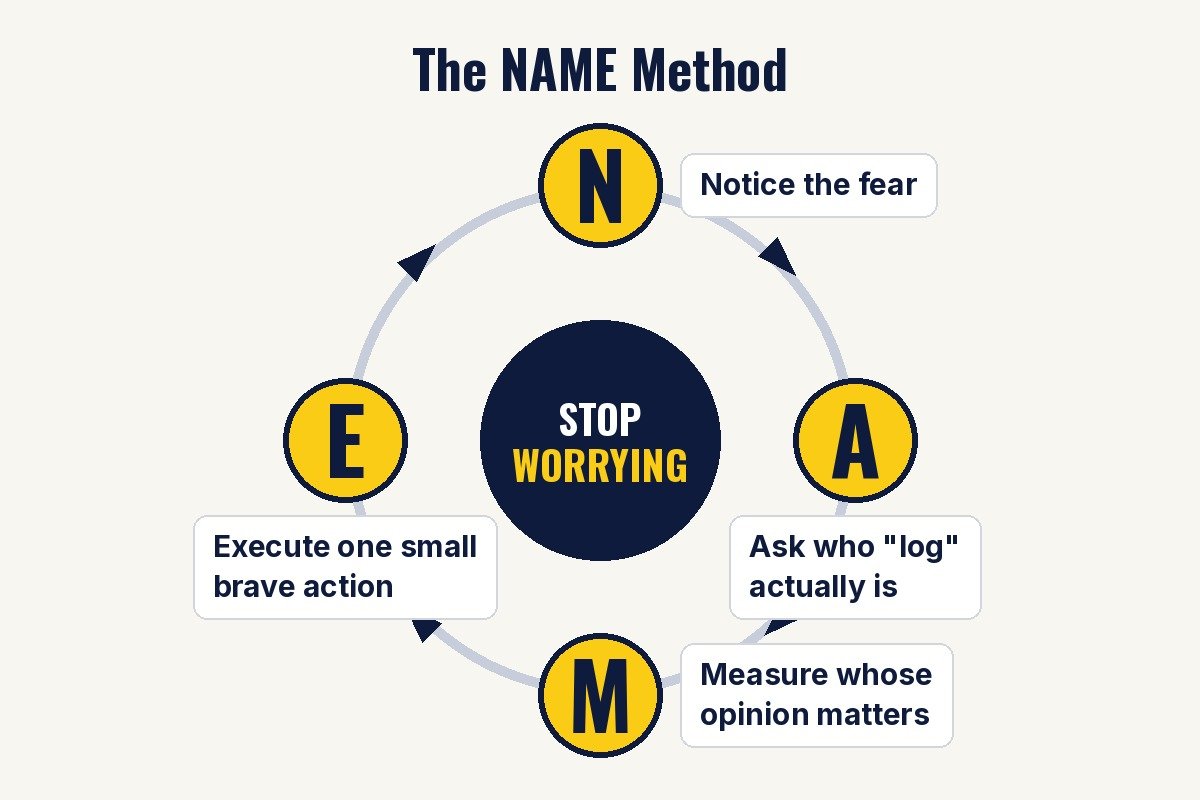
You don’t need to stop caring about everyone. You need to stop giving everyone a vote. Here’s a simple four-step method I call NAME.
N: Notice the fear
You can’t change a reaction you don’t catch. The fear usually shows up in your body first: a tight chest before replying to a family group message, or your stomach dropping before you share an idea.
How to do it: When you feel it, pause and say to yourself, “This is the fear of judgement, not a fact.” Then take three slow breaths before you decide anything.
Example: You’re about to post your first video, and your thumb hovers over “Delete.” Naming the feeling gives you a few seconds of choice instead of an automatic retreat.
A: Ask who “log” actually is
“People” is a huge, scary word. Make it small and specific.
How to do it: Write down the exact names of the people whose reaction you’re worried about. Next to each name, write the one comment you expect from them.
Example: Many people find their list is just three or four names, and one of them is a relative they meet twice a year. Once you can see the names, the fear usually feels smaller and more manageable.
M: Measure whose opinion matters
Not every opinion deserves equal weight. For each name on your list, ask:
- Does this person truly care about my well-being?
- Do they understand my situation and what I want?
- Will their opinion matter to me in five years?
How to do it: Circle only the names that get a “yes” to at least two questions. That’s your trusted circle, maybe your parents, your partner, a mentor or one close friend. Listen to them with respect. For everyone else, remind yourself: “Their opinion is information, not instruction.”
E: Execute one small brave action
Confidence doesn’t come before action. It comes after it.
How to do it: Pick one thing you’ve avoided because of judgement and shrink it until it feels about 20% scary, not 100%. Do it within the next 48 hours. Afterwards, write one line: “What I feared” and “What actually happened.”
Example: Instead of announcing a career change to the whole family, you tell one supportive cousin first. Each small action gives your mind proof that you can handle other people’s reactions.
Putting NAME into practice
Imagine someone, let’s call her Riya, who loves baking. She dreams of taking orders from home, but she keeps postponing it. “What will my relatives say? An engineer selling cakes?”
Using NAME, Riya first notices the fear. Then she writes down who she’s really worried about: two aunts and one neighbour. When she measures their opinion, she realises it won’t matter much to her in five years, while her parents and husband, the people she trusts, are supportive.
So she takes one small step: she posts one photo of her cake on her WhatsApp status with “Now taking cake orders.” That’s it. Not a big launch. Just one brave action.
Whatever the response, Riya learns something important: the fear was louder than the reality.
What If People Really Do Judge You?
Sometimes they will. Let’s be real about that.
A judgement often says more about the other person’s fears, values or experiences than about you. A relative who says “Stop experimenting and settle down” may be speaking from their own fear of risk.
You can respond with respect and still choose your path. A few lines that work well:
- “I understand your concern, and I’ve thought about this carefully.”
- “Thank you for caring. I’ll let you know how it goes.”
- “I know it’s different from what you expected. I’d like to try it my way.”
You don’t owe anyone a long defence. One calm sentence, said kindly and without apology, is usually enough.
And if the fear of judgement feels constant, heavy, or starts affecting your sleep, work or relationships, please speak with a qualified mental health professional. Asking for that support is a sign of strength.
FAQs
Is it normal to care what others think about me?
Yes, completely. Wanting acceptance is a basic human need. It only becomes a problem when other people’s possible opinions start making your decisions for you.
Why do I care what people think of me so much?
Often it comes from how we were raised, past experiences of criticism, and low self-trust. When you don’t trust your own judgement, other people’s opinions start to feel more important than your own.
How do I get over the fear of judgement?
Start small. Name exactly who you’re afraid of, decide whose opinion truly matters, and take one small brave action at a time. Each action builds evidence that you can handle judgement.
Try This Today
Each of these takes less than 10 minutes:
- Make your “log” list. Write the names of the people whose judgement you fear, then circle the two or three whose opinion truly matters.
- Finish the sentence. Write “If I didn’t care what people think, I would…” three times, and choose one answer to act on this week.
- Prepare your one-liner. Pick the sentence you’ll use the next time someone questions your choice, and say it out loud twice so it feels natural.
People will always talk. That part isn’t in your control. How much power you give their words is.
If you keep holding yourself back because of “log kya kahenge,” it’s usually a deeper pattern of self-trust, and that’s exactly the kind of work I do in life coaching in Surat or online.
Ready to take your first step? Book a free 30-minute coaching call with me. No pressure, just clarity on what’s holding you back and what your next step looks like.