
You open Instagram for two minutes. Someone from your college just bought a car. A friend is on a trip abroad. A cousin got promoted. You close the app, and your own life suddenly feels smaller than it did two minutes ago.
If you’re searching for how to stop comparing yourself to others, I want you to know this first: comparison isn’t a sign that something is wrong with you. Every human mind does it. The real question is whether your comparisons help you grow, or quietly make you feel “not enough.”
Let’s look at why it happens, how to tell useful comparison from harmful comparison, and five steps that actually work.
Why Do We Compare Ourselves to Others?
In 1954, social psychologist Leon Festinger proposed social comparison theory. His idea was simple: when we don’t have a clear, objective way to judge how we’re doing, we look at other people to measure ourselves.
That made sense when we compared ourselves with a few classmates or neighbours. Today, we see hundreds of people every day, and mostly their best moments.
Many of us also grew up with comparison built into daily life. Marks were compared on result day. Relatives asked, “What is Sharma ji’s son doing now?” Siblings were measured against each other. By the time we’re adults, comparing has become automatic. We often don’t notice we’re doing it.
Healthy vs Unhealthy Comparison
Not all comparison is bad. Seeing someone ahead of you can be useful, if it gives you direction instead of taking away your energy.
Healthy comparison sounds like:
- “She built that slowly. What can I learn from how she did it?”
- “If he can do it, maybe I can try too.”
- “This shows me what I actually want.”
Unhealthy comparison sounds like:
- “Everyone is ahead of me.”
- “I’m already too late.”
- “What’s the point of even trying?”
Here’s a quick test I use. After you look at someone’s life, ask: “Do I feel like doing something, or like giving up?” If you feel like doing something, the comparison is working for you. If you feel like giving up, it’s working against you.
The Hidden Problem: You’re Comparing Your Inside to Their Outside
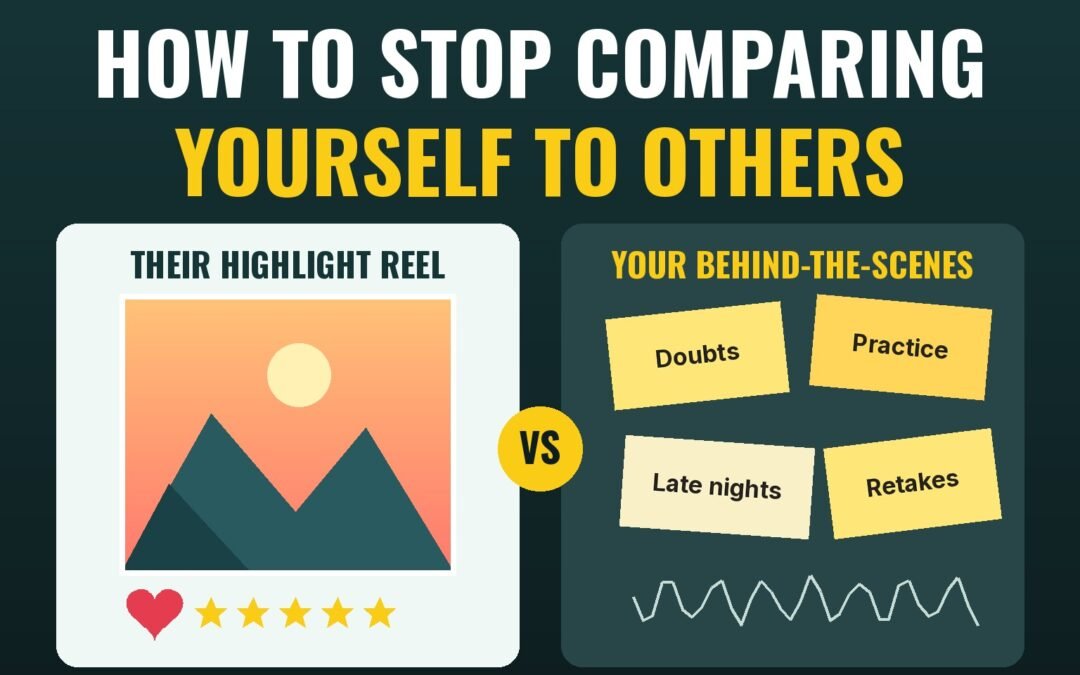
When you compare, you’re putting your whole life, with its doubts, unpaid bills and bad days, next to a small, edited part of someone else’s life.
You see the new car, not the loan EMI. You see the promotion, not the late nights. You see the wedding photos, not the arguments before them.
There’s a second trap too: comparing your chapter 2 with someone else’s chapter 10. The person you’re measuring yourself against may have started years before you, failed a few times you never saw, or had support you didn’t have.
Next time it happens, ask yourself: “What don’t I know about their journey?” That one question brings the comparison back to reality.
I see this a lot with talented people. Being capable isn’t enough if comparison keeps you from showing up consistently, which I explored in why high potential doesn’t always lead to success.
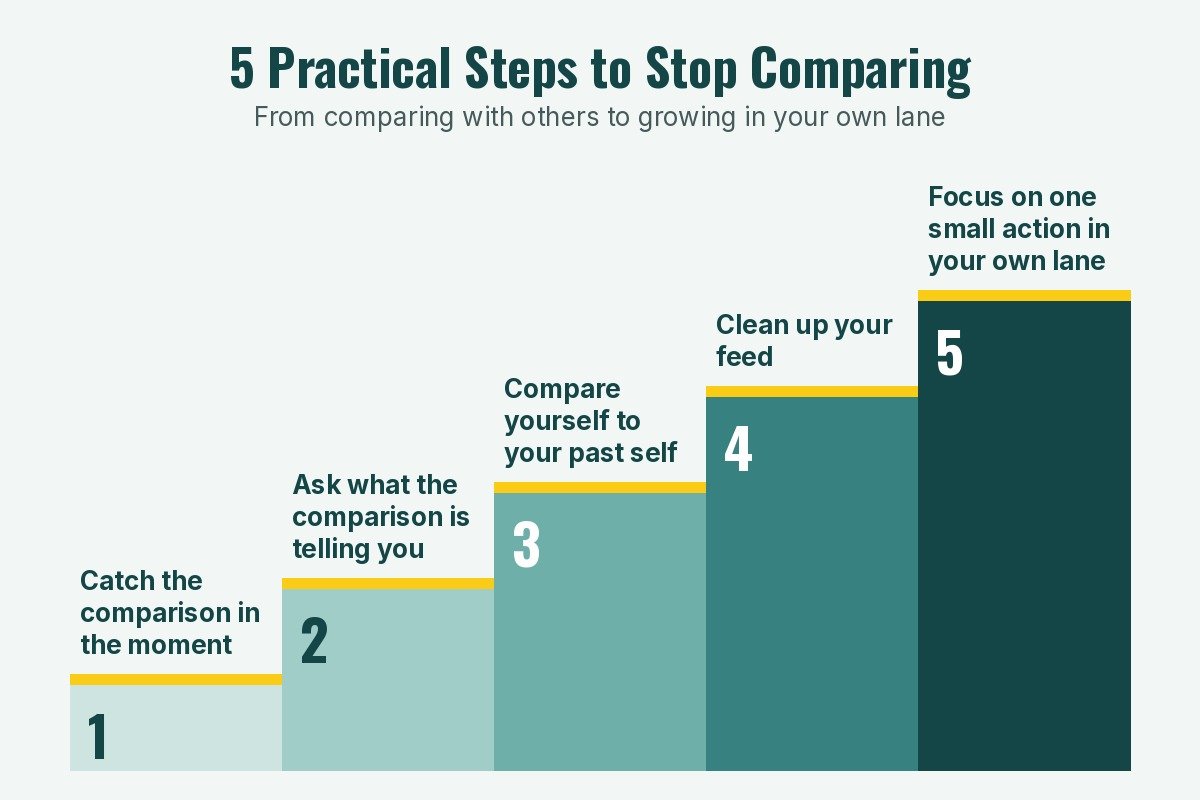
How to Stop Comparing Yourself to Others: 5 Practical Steps
1. Catch the comparison in the moment
You can’t change a habit you don’t notice. The signal is usually a sudden drop in mood after scrolling, a conversation or a family function.
How to do it: When you feel that drop, pause and say, “I’m comparing again.” Then note three things in your phone: who, what (money, looks, career, marriage) and how you felt. After a week, you’ll see your pattern clearly.
Example: You might discover that most of your comparisons happen on Sunday nights, or always about one topic, like salary. That tells you exactly where to focus.
2. Ask what the comparison is telling you
Comparison often points to something you want for yourself.
How to do it: Complete this sentence: “I feel jealous of ___ because I want ___.” Then ask, “Do I really want this, or do I just want to look like I have it?”
Example: Envy of a friend’s business may really be a wish for more freedom in your work. Envy of someone’s fitness may be a wish to take better care of yourself. That’s no longer jealousy. It’s direction.
3. Compare yourself to your past self
The only fair comparison is with who you were six months or a year ago.
How to do it: Take two minutes and write three ways you’ve grown in the last year: a skill, a habit, a hard situation you handled better. Keep a small “wins” note in your phone and add one line every week.
Example: “Last year I couldn’t speak in meetings. This year I presented once.” Small progress like this is easy to miss when you’re busy watching others.
4. Clean up your feed
Your phone shapes your mind more than you realise.
How to do it: Scroll your following list for five minutes. For each account, ask: “Does this leave me inspired or empty?” Mute the ones that leave you empty. You don’t have to unfollow anyone dramatically. Also keep your phone away for the first 30 minutes after waking and the last 30 minutes before sleep.
Example: Muting a few “perfect life” accounts, and following people who share real learning, can change how you feel after scrolling.
5. Focus on one small action in your own lane
Comparison grows when you’re stuck watching others instead of building your own life.
How to do it: Whenever you catch the thought “everyone is ahead of me,” answer it with one action you can finish in 15 minutes today. Apply for one job, read ten pages, or practise one skill.
Example: Instead of spending an hour reading a former classmate’s career updates, you spend 15 minutes updating your own resume. If staying consistent is hard once the motivation fades, my post on how to build discipline when you don’t feel motivated can help.
When Comparison Hits Hardest (and What to Say to Yourself)
Some moments trigger comparison more than others. Knowing them helps you prepare.
- Result day or appraisal time: “Their result doesn’t decide my next step. What’s one thing I can improve?”
- Family functions: When someone asks “Why aren’t you married yet?” or “How much do you earn?”, you can say, “I’m working on my own plan, I’ll share when it’s ready,” and change the topic.
- Scrolling late at night: “I’m tired, and tired minds compare more. I’ll look at this tomorrow.”
- Friends’ big news: “I can be happy for them and still be on my own path.” Sending a genuine congratulations message often eases the sting.
If comparison is constantly affecting your mood, self-worth or sleep, please also reach out to a qualified mental health professional. Getting support early is always a good decision.
FAQs
Why do I compare myself to others so much?
Usually because comparison became a habit early in life, and social media now shows us more people’s highlights than ever before. Low self-trust makes it stronger, because you look outside yourself to judge whether you’re doing okay.
Is it bad to compare yourself with others?
Not always. Comparison that inspires you and gives you direction can be useful. It becomes harmful when it makes you feel “not enough” or stops you from taking action.
How do I stop comparing myself to others on social media?
Notice how certain accounts make you feel, mute the ones that leave you feeling low, keep phone-free time after waking and before sleep, and remember you’re seeing highlights, not full lives.
Try This Today
Each of these takes less than 10 minutes:
- Mute three accounts that regularly leave you feeling “not enough.”
- Write three wins from the last year in a note on your phone, and title it “My own lane.”
- Turn one envy into one action. Complete “I feel jealous of ___ because I want ___,” then do one 10-minute step towards that want today.
Someone will always be ahead of you in something, and someone will always be behind you. Your job isn’t to win against everyone. It’s to become a little better than you were yesterday.
If you keep feeling “behind” no matter what you achieve, there’s usually a deeper belief underneath it. That’s what we work on together in my life coaching in Surat or online.
Want to stop measuring your life against everyone else’s? Book a free 30-minute coaching call with me and let’s find your next step, in your own lane.