
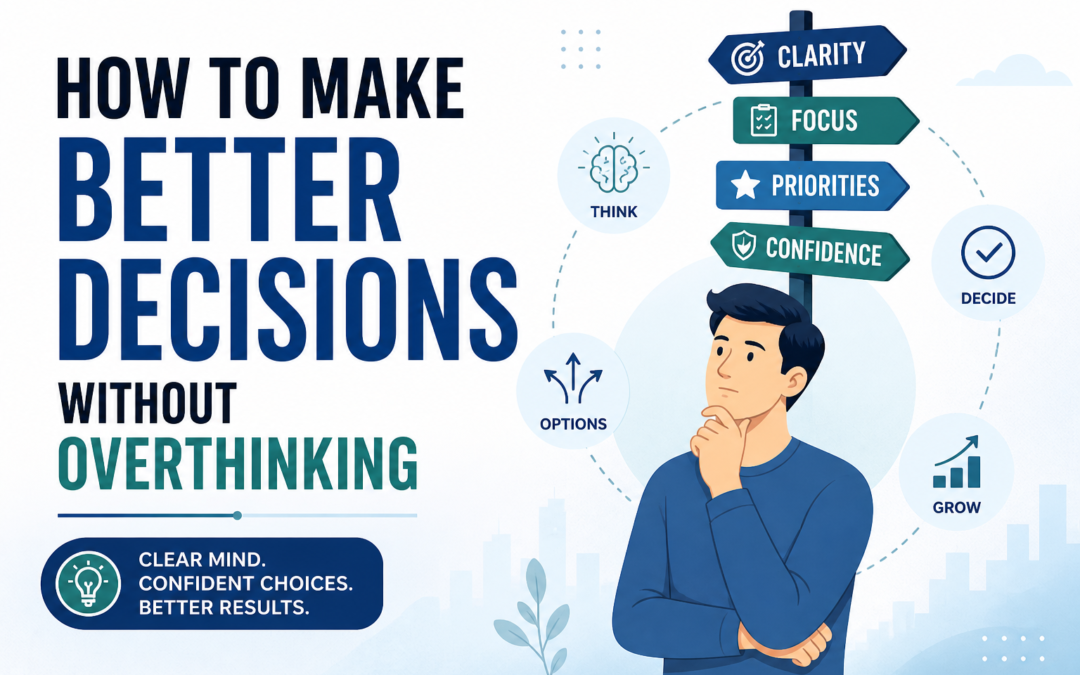
Most people don’t struggle with lack of options.
They struggle with choosing.
You think about:
- What if this is the wrong choice?
- What if I regret it later?
- What if there’s a better option?
And suddenly, a simple decision feels heavy.
So you delay… or avoid it completely.
But here’s something important:
👉 Decision-making is not about being right.
👉 It’s about being clear.
🔍 Why Decisions Feel So Difficult
Let’s break this differently.
Decisions feel hard when:
- You want certainty before acting
- You try to eliminate all risk
- You rely on too many opinions
You’re not confused because the decision is complex.
👉 You’re confused because your thinking is cluttered.
🧠 The Real Issue: Lack of Decision Filters
Most people try to make decisions by thinking more, but strong decisions come from using clear filters that simplify the process
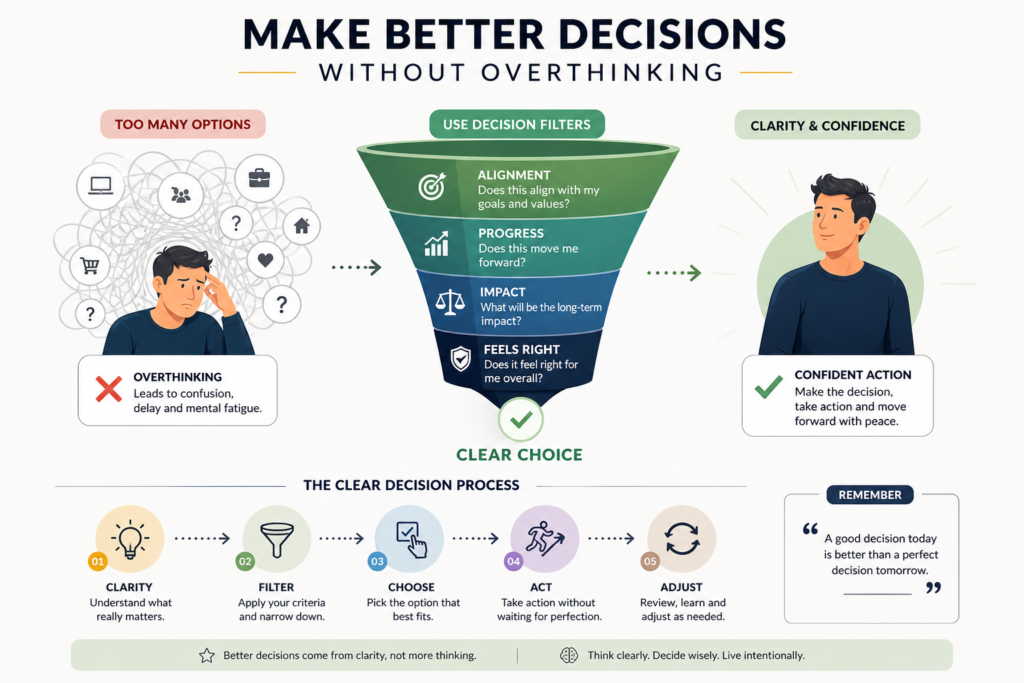
When you apply the right filters, confusion reduces and decisions become clearer and faster.
⚠️ What Are Decision Filters?
Decision filters are simple criteria that guide your choices.
They reduce confusion.
They eliminate unnecessary thinking.
Example:
Instead of:
❌ “Should I take this opportunity?”
Ask:
✅ Does this align with my priorities?
✅ Does this move me forward?
✅ Does this feel right long-term?
Now the decision becomes clearer.
🔁 The Decision Trap Most People Fall Into
Here’s a pattern you might recognize:
Too many options → Too much thinking → No decision → Mental fatigue
The problem is not lack of intelligence.
👉 It’s lack of structure.
🚀 A Clear Way to Make Decisions
Let’s simplify this process.
1️⃣ Define What Matters First
Before deciding anything, ask:
👉 What actually matters to me in this situation?
Because if you don’t define this:
👉 You’ll keep switching between options
2️⃣ Limit Your Options
More options = more confusion
Instead of:
- 5–6 choices
Reduce it to:
👉 2–3 clear options
Your brain works better with fewer variables.
3️⃣ Accept Imperfect Decisions
This is where most people get stuck.
They want:
👉 The perfect decision
But every decision has:
- Trade-offs
- Uncertainty
👉 Progress comes from deciding, not perfect choosing
4️⃣ Set a Decision Boundary
Don’t let decisions stay open forever.
Give yourself:
- A time limit
- A mental boundary
Example:
👉 “I will decide this today”
This reduces mental load.
5️⃣ Trust the Process, Not the Outcome
You cannot control outcomes completely.
But you can control:
- How you think
- How you decide
👉 Good decisions come from a clear process — not perfect results
🧠 A Simple Decision Framework
Use this:
Clarity → Filter → Choose → Act → Adjust
- Get clear on what matters
- Apply your filters
- Make a choice
- Take action
- Adjust if needed
✍️ Pause & Reflect
Before your next decision, ask:
- What am I overcomplicating here?
- What actually matters in this situation?
- Am I delaying because of fear or confusion?
👉 These questions alone can simplify most decisions.
❓ Common Questions About Decision-Making
How do I stop doubting my decisions?
Focus on your decision process, not outcome. Doubt reduces when clarity increases.
What if I make the wrong decision?
Every decision teaches something. You adjust as you move forward.
Why do I keep delaying decisions?
Because you’re waiting for certainty instead of working with clarity.
🎯 Final Thoughts
You don’t need more information.
You need:
👉 Clear thinking
👉 Fewer options
👉 Strong filters
Better decisions don’t come from overthinking.
They come from:
👉 Understanding what matters
👉 Choosing based on that
👉 Moving forward
📞 Want to Improve Your Decision Clarity?
If you struggle with confusion, overthinking, or second-guessing yourself, the issue is not lack of ability — it’s lack of clarity in thinking.
I help individuals:
- Simplify decision-making
- Build clarity
- Take confident action
👉 Book a clarity session on +91 99 98 40 45 50 and start making better decisions.