
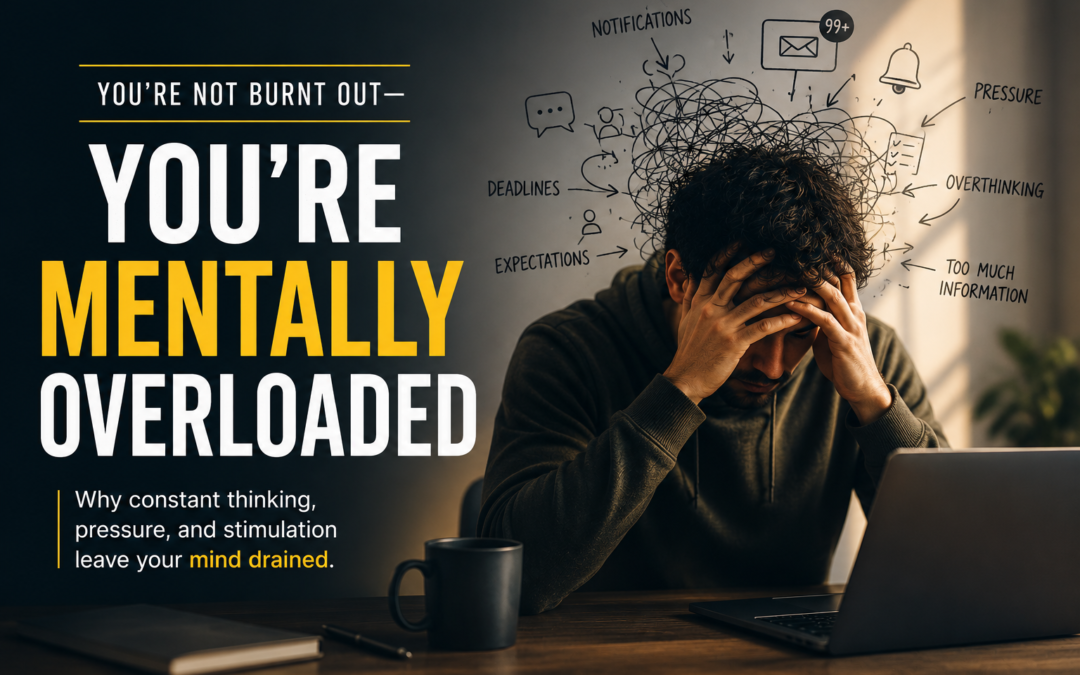
Many people today think they’re burnt out.
But sometimes, that’s not the real problem.
Sometimes you’re not burnt out.
👉 You’re mentally overloaded.
There’s a difference.
Burnout usually comes from prolonged physical or emotional exhaustion.
Mental overload comes from:
- constant stimulation
- nonstop thinking
- emotional pressure
- too much information without recovery
And for many people, this has quietly become normal.
What Mental Overload Actually Looks Like
It’s not always dramatic.
Sometimes it looks like:
- struggling to focus
- procrastinating simple tasks
- feeling mentally tired all day
- scrolling endlessly without purpose
- constantly thinking, but rarely feeling clear
You may not even be doing “too much” physically.
But mentally?
👉 Your brain never truly slows down.
Your Mind Rarely Gets Silence Anymore
From the moment people wake up, the brain starts consuming:
- notifications
- messages
- videos
- opinions
- pressure
- comparisons
Even during rest, the mind stays active.
There is always:
👉 something to check
👉 something to respond to
👉 something to think about
And over time, that creates mental fatigue.
The Pressure Most People Don’t Notice
A lot of mental exhaustion comes from invisible pressure.
Pressure to:
- improve constantly
- stay productive
- keep up with others
- figure life out quickly
So even while resting, many people feel guilty for “not doing enough.”
The body may pause.
But the mind doesn’t.
Why You Keep Avoiding Things
Mental overload often creates avoidance.
Not because you are lazy.
But because your brain is overloaded and looking for relief.
That’s why people:
- delay important work
- avoid decisions
- seek distractions
- lose mental clarity
The issue is not always discipline.
Sometimes the issue is:
👉 too much mental noise.
One Realization That Changes Everything
A client once said:
“I thought I needed motivation, but honestly… I think my brain is just tired.”
That awareness changed the approach completely.
Instead of adding:
- more pressure
- more routines
- more self-improvement
…the focus became reducing overload.
And slowly, clarity returned.
Sometimes Growth Looks Like Less
Not every solution requires:
- doing more
- learning more
- pushing harder
Sometimes growth begins when you:
- reduce mental clutter
- slow down stimulation
- create space for clear thinking
Because clarity often returns when overload disappears.
🪞A Question Worth Asking Yourself
When was the last time your mind experienced real silence?
Not entertainment.
Not scrolling.
Not distraction.
Just silence.
Final Thoughts
You may not be lazy.
You may not even be burnt out.
You may simply be mentally overloaded.
And your mind is asking for something most people ignore:
👉 Space.
📞 If This Felt Familiar…
Mental overload affects:
- focus
- clarity
- emotional stability
- decision-making
I help individuals understand the deeper mental patterns that create stress, confusion, and emotional exhaustion.
👉 Book a clarity session at +91 99 98 40 45 50 and start creating mental clarity again.